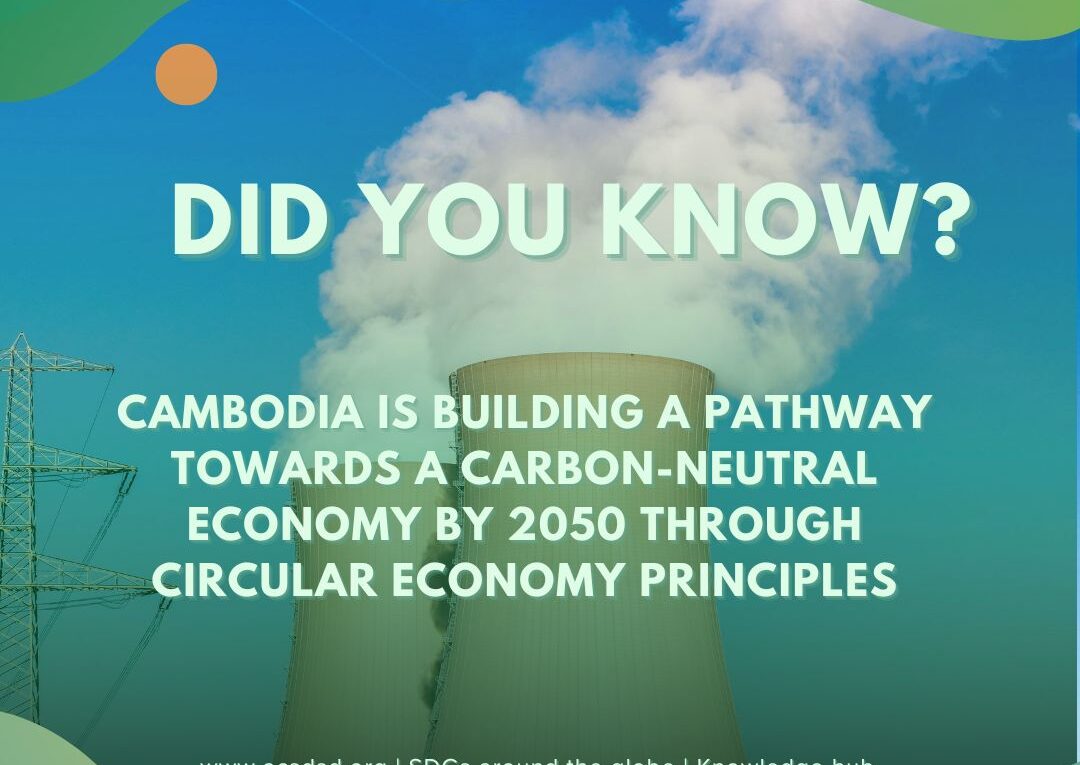
Did You Know? Cambodia is building a pathway towards a carbon-neutral economy by 2050 through circular economy principles
Over the past two decades, Cambodia has recorded an average annual economic growth rate of 7.3%. However, rapid growth has also increased demand for energy, transport, and natural resources, while exposing the country to greater climate risks. According to the Global Climate Risk Index, Cambodia ranked among the world’s most climate-vulnerable countries between 1999 and 2018.
To address these challenges, Cambodia has adopted a National Circular Economy Strategy and Action Plan, alongside its Long-Term Strategy for Carbon Neutrality (LTS4CN) and updated climate commitments. These efforts aim to transform key sectors such as agriculture, energy, and transport.
🚜 In agriculture, Cambodia is promoting biodigesters, organic fertilisers, composting technologies, and lower-emission farming practices.
⚡ In energy, the country is pursuing energy efficiency standards, renewable energy expansion, grid modernisation, and waste-to-energy solutions.
🚍 In transport, Cambodia is encouraging public transportation, electric vehicles, rail freight, and low-emission transport systems as part of its journey towards carbon neutrality by 2050.
Cambodia’s experience highlights how the circular economy is not only about waste management—it is about redesigning #Resilience.
Source: ERIA Research Project Report FY2023 No. 27 “ Integrative Report on Implementation of the Circular Economy in ASEAN” Edited by Intan Murnira Ramli Michelle Chandra Kasih
Source:
Integrative Report on Implementation of the Circular Economy in ASEAN https://asean.org/book/integrative-report-on-implementation-of-the-circular-economy-in-asean/
Join the ACSDSD ASEAN Networking Symposium to explore how circular economy solutions, energy transition, digital transformation, and climate resilience can help shape a more sustainable future for ASEAN. 🌱🌏🤝