Why ASEAN’s role could grow in significance in the Post‑2030 SDGs era
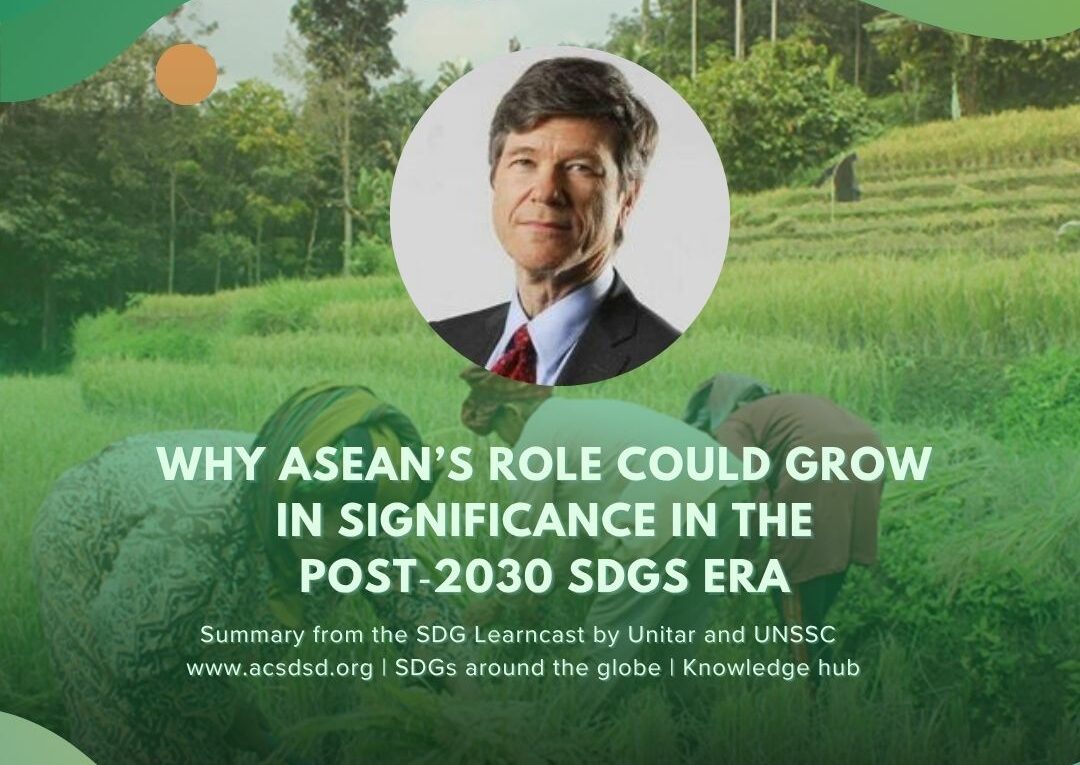
“…the region [ASEAN] becomes very important for solutions.
It becomes very important for integrated infrastructure: power, water, transport, digital access, which is beyond a one-country solution.”
ACSDSD summarized how the podcast titled SDGs and Beyond: Rethinking Multilateralism for the Post-2030 Era by Professor Jeffrey Sachs, President of the UN Sustainable Development Solutions Network with how it involves ASEAN.
Listen to this podcast >> here
SDGs are in the progress of transformation from a western-dominated world to a regionally driven one.
For #ASEAN and other regional organisations, this moment presents a unique opportunity to establish a financing system for the region, using the SDGs as its DNA. Regional groupings are becoming essential actors in global diplomacy and problem-solving. Many of today’s challenges, from climate change and energy security to digital governance, are #Supranational in nature and cannot be solved by any country acting alone.
“The region becomes very important for solutions. It becomes very important for integrated infrastructure: power, water, transport, digital access, which is beyond a one-country solution.”
— Professor Jeffrey Sachs, President, UN Sustainable Development Solutions Network (SDSN)
ACSDSD reflects on key insights from the podcast “SDGs and Beyond: Rethinking Multilateralism for the Post-2030 Era” featuring Professor Jeffrey Sachs.
As the world transitions from a predominantly Western-led order to an increasingly multipolar world, sustainable development is no longer driven solely by national governments or global institutions. Regional groupings are emerging as critical actors in shaping solutions for shared challenges.
For ASEAN, this presents a unique opportunity to move beyond coordination and become a platform for implementation. From climate resilience and energy transition to digital transformation and regional connectivity, many of today’s challenges are inherently supranational and cannot be solved by any country acting alone.
ASEAN has the potential to pioneer a regional development architecture—one that integrates financing, infrastructure, technology, and policy cooperation, with the SDGs serving as its guiding DNA.
As Professor Sachs notes, solutions increasingly lie at the regional level. Whether through interconnected power grids, resilient transport networks, shared digital infrastructure, or innovative financing mechanisms, ASEAN can play a defining role in shaping the post-2030 sustainable development agenda.
At ACSDSD, we offer a platform for meaningful conversations on the future of sustainable development in ASEAN. We invite our partners, policymakers, researchers, businesses, youth leaders, and development practitioners to join this conversation.
What role do you think ASEAN should play in shaping the post-2030 sustainable development agenda?
Through regional cooperation, ASEAN can contribute to sustainable development by developing cross-border clean energy systems, establishing regional disaster resilience funds, and creating practical governance frameworks for artificial intelligence and the digital economy.
Such initiatives could serve as models for other regions around the world.
In this sense, the post-2030 SDG agenda may not be about drafting another set of 17 goals. Rather, it may be about creating new problem-solving systems that can turn sustainable development into a practical reality.
ACSDSD seeks to provide a platform for meaningful dialogue on the future of sustainable development in ASEAN. We invite partners, policymakers, researchers, businesses, youth leaders, and development practitioners to join this conversation and explore how ASEAN can contribute to shaping the next chapter of sustainable development.
เมื่อคำตอบของความยั่งยืนอยู่ที่ระดับภูมิภาค: บทเรียนจาก Jeffrey Sachs ต่ออนาคตของอาเซียนหลังปี 2030
“ภูมิภาคมีความสำคัญอย่างยิ่งต่อการสร้างทางออกของปัญหาโลกในอนาคต โดยเฉพาะการพัฒนาโครงสร้างพื้นฐานแบบบูรณาการ ไม่ว่าจะเป็นพลังงาน น้ำ การคมนาคม และการเข้าถึงดิจิทัล ซึ่งล้วนเป็นเรื่องที่เกินกว่าประเทศใดประเทศหนึ่งจะจัดการได้เพียงลำพัง”
— ศาสตราจารย์ Jeffrey Sachs ประธานเครือข่าย UN Sustainable Development Solutions Network (SDSN)
ACSDSD สรุปเรียบเรียงจากพอดแคสต์ “SDGs and Beyond: Rethinking Multilateralism for the Post-2030 Era” ซึ่งนำเสนอโดยศาสตราจารย์ Jeffrey Sachs หนึ่งในนักคิดด้านการพัฒนาที่ยั่งยืนที่มีบทบาทสำคัญในเวทีโลก
หนึ่งในประเด็นที่น่าสนใจที่สุดของการสนทนาครั้งนี้ คือแนวคิดที่ว่าโลกกำลังก้าวผ่านจากระเบียบโลกที่ขับเคลื่อนโดยชาติตะวันตก ไปสู่โลกหลายขั้ว (Multipolar World) ที่ภูมิภาคต่าง ๆ มีบทบาทมากขึ้นในการกำหนดทิศทางการพัฒนา เศรษฐกิจ และความร่วมมือระหว่างประเทศ
ในบริบทดังกล่าว การพัฒนาที่ยั่งยืนไม่ได้เป็นภารกิจของรัฐบาลระดับชาติหรือองค์กรระหว่างประเทศเพียงอย่างเดียวอีกต่อไป แต่กำลังกลายเป็นพื้นที่ที่องค์กรระดับภูมิภาคมีบทบาทสำคัญมากขึ้นในการออกแบบและขับเคลื่อนแนวทางแก้ไขปัญหาร่วมกัน
สำหรับอาเซียน นี่อาจเป็นช่วงเวลาสำคัญในการก้าวข้ามบทบาทของการเป็นเพียงเวทีประสานความร่วมมือ ไปสู่การเป็นกลไกขับเคลื่อนการดำเนินงานอย่างเป็นรูปธรรม
ไม่ว่าจะเป็นการเสริมสร้างความยืดหยุ่นต่อการเปลี่ยนแปลงสภาพภูมิอากาศ การเปลี่ยนผ่านด้านพลังงาน การเชื่อมโยงโครงสร้างพื้นฐานดิจิทัล หรือการพัฒนาความเชื่อมโยงของภูมิภาค ความท้าทายเหล่านี้ล้วนมีลักษณะ “เหนือพรมแดน” (Supranational) และไม่สามารถแก้ไขได้โดยประเทศใดประเทศหนึ่งเพียงลำพัง
ภายใต้บริบทโลกหลังปี 2030 อาเซียนจึงมีโอกาสที่จะพัฒนา “สถาปัตยกรรมการพัฒนาระดับภูมิภาค” (Regional Development Architecture) ของตนเอง ซึ่งเชื่อมโยงทั้งด้านการเงิน โครงสร้างพื้นฐาน เทคโนโลยี และความร่วมมือเชิงนโยบาย โดยมีเป้าหมายการพัฒนาที่ยั่งยืน (SDGs) เป็นกรอบแนวคิดหลักในการกำหนดทิศทาง
แนวคิดดังกล่าวอาจรวมถึงการพัฒนากลไกระดมทุนระดับภูมิภาค การเชื่อมโยงโครงข่ายพลังงานสะอาด การสร้างโครงสร้างพื้นฐานดิจิทัลร่วมกัน หรือการส่งเสริมความร่วมมือด้านนวัตกรรมและเทคโนโลยี เพื่อรับมือกับความท้าทายที่ประเทศสมาชิกมีร่วมกัน
ดังที่ศาสตราจารย์ Sachs ชี้ให้เห็น คำตอบของหลายปัญหาในศตวรรษที่ 21 กำลังอยู่ที่ระดับภูมิภาคมากขึ้นเรื่อย ๆ ไม่ว่าจะเป็นโครงข่ายไฟฟ้าข้ามพรมแดน ระบบคมนาคมที่เชื่อมโยงกัน โครงสร้างพื้นฐานดิจิทัลร่วม หรือกลไกการเงินรูปแบบใหม่ที่สามารถสนับสนุนการพัฒนาที่ยั่งยืนได้ในระยะยาว
ในโลกที่กำลังเปลี่ยนผ่านสู่ความเป็นพหุขั้ว อาเซียนจึงไม่ได้เป็นเพียงผู้มีส่วนร่วมในวาระการพัฒนาที่ยั่งยืนหลังปี 2030 เท่านั้น แต่อาจมีบทบาทสำคัญในการร่วมกำหนดรูปแบบของความร่วมมือและการพัฒนาที่ยั่งยืนสำหรับอนาคตของภูมิภาคและของโลกด้วยเช่นกัน
คุณคิดว่าอาเซียนควรมีบทบาทอย่างไรในการกำหนดวาระการพัฒนาอย่างยั่งยืนหลังปี 2030?
Courtesy of Interview from SDG Learncast by Unitar and UNSSC
Access here https://www.unsdglearn.org/podcast/sdgs-and-beyond-rethinking-multilateralism-for-the-post-2030-era/