From Complementarities Initiatives 1.0 to CI 2.0: The GREEN Agenda ✨🌱
The Complementarities Initiatives Framework for Action (CI 1.0) identified five interlinked priority areas: poverty eradication, infrastructure and connectivity, sustainable management of natural resources, sustainable consumption and production, and resilience. The COVID-19 pandemic significantly impeded progress across these areas, making the achievement of the 2030 targets more challenging.
📘 ASEAN Complementarities Focus Areas (Formerly)
ASEAN Complementarities Initiatives
Infrastructure and Connectivity
Sustainable Consumption & Production
Resilience against climate change
Sustainable Management of Natural Resource
REVIEW OF CI 1.0 PRIORITY AREAS PROGRESS
Progress of Poverty Eradication: Despite significant efforts, ASEAN is unlikely to meet the 2030 target for poverty eradication (SDG Goal 1: No Poverty). Several factors hinder progress, including economic disparities among AMS. The COVID-19 pandemic also reversed years of poverty reduction, especially in lower-middle-income countries. High-income inequality within several AMS, vulnerability to economic shocks and crises, and the impacts of climate change and natural disasters all exacerbate poverty. Challenges in data collection and monitoring further impede accurate assessment of poverty levels and program effectiveness.
-

- Air connectivity
-

- Road connectivity
Progress of Infrastructure and Connectivity: This area has shown the most significant progress among the CI 1.0 Priority Areas. The focus was on transportation, broadband, energy, water, and sanitation. Initiatives such as the Master Plan on ASEAN Connectivity (MPAC) 2025, which has nearly 84% of its 143 key implementing measures completed or in progress, have been instrumental. ESCAP’s assessment using 36 indicators across 12 SDGs showed “accelerating progress” for 28 indicators and “maintaining progress” for 5, with only 3 showing “reversing trends”. Despite this strong progress, integrating climate change considerations and renewable energy remains challenging and crucial for future sustainability.

Progress of Sustainable Management of Natural Resources: Between 2017 and 2025, ASEAN has made notable progress in this area (Priority Area 3) through measures for biodiversity conservation, reducing environmental impacts, and fostering partnerships (e.g., with EU, Australia, Japan, and UN). ESCAP’s measurement of this area with 20 indicators across 8 SDGs showed 12 with “accelerating progress,” 4 “maintaining progress,” and 4 “reversing trends”. However, based on available data, ASEAN is not fully on track to achieve all aspects of this priority by 2030. Significant challenges remain concerning environmental degradation, climate change impacts, balancing economic growth with sustainability, transboundary issues, and implementation gaps.
Progress of Sustainable Consumption and Production (SCP): AMS have undertaken diverse national efforts to implement SCP principles in agriculture, forestry, energy, and waste management. Initiatives include Green Public Procurement (GPP), Extended Producer Responsibility (EPR) schemes, and plastic reduction campaigns. ESCAP measured progress for Priority Area 4 with 8 indicators across 5 SDGs. Four indicators showed “accelerating progress,” one “maintaining progress,” and three “reversing trends” (Renewable Energy Share, Material Footprint, and Domestic Material consumption). Despite some improvements in CO2 and Greenhouse Gas emissions, significant challenges persist in achieving SCP goals, particularly concerning plastics and food waste.
Progress of Resilience:Progress in Resilience (Priority Area 5) shows a consistent reversing trend, according to ESCAP measurements. Out of 8 indicators across 3 SDGs, 5 showed “accelerating progress,” 1 “maintaining progress,” and 2 “reversing trends” (deaths/missing/ affected from disaster, and economic loss from disaster). This indicates that despite some positive developments, overall resilience is declining, primarily due to increasing impacts from disasters. ASEAN faces challenges in building adaptive, anticipatory, absorptive, and Complementarities Initiative 2.0 13 transformative capacities, further compounded by increasing global uncertainties and environmental risks. A lack of sufficient and compatible data across AMS also hinders accurate measurement and effective policy responses for resilience.
The Asia and the Pacific SDG Progress Report 2025 noted that none of the 17 SDGs are on track for the broader region, with slow or regressing progress in resilience-linked areas.
NEW PRIORITY AREAS FOR CI 2.0
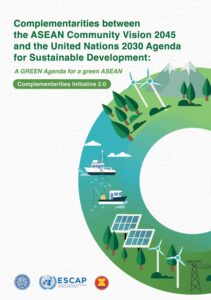
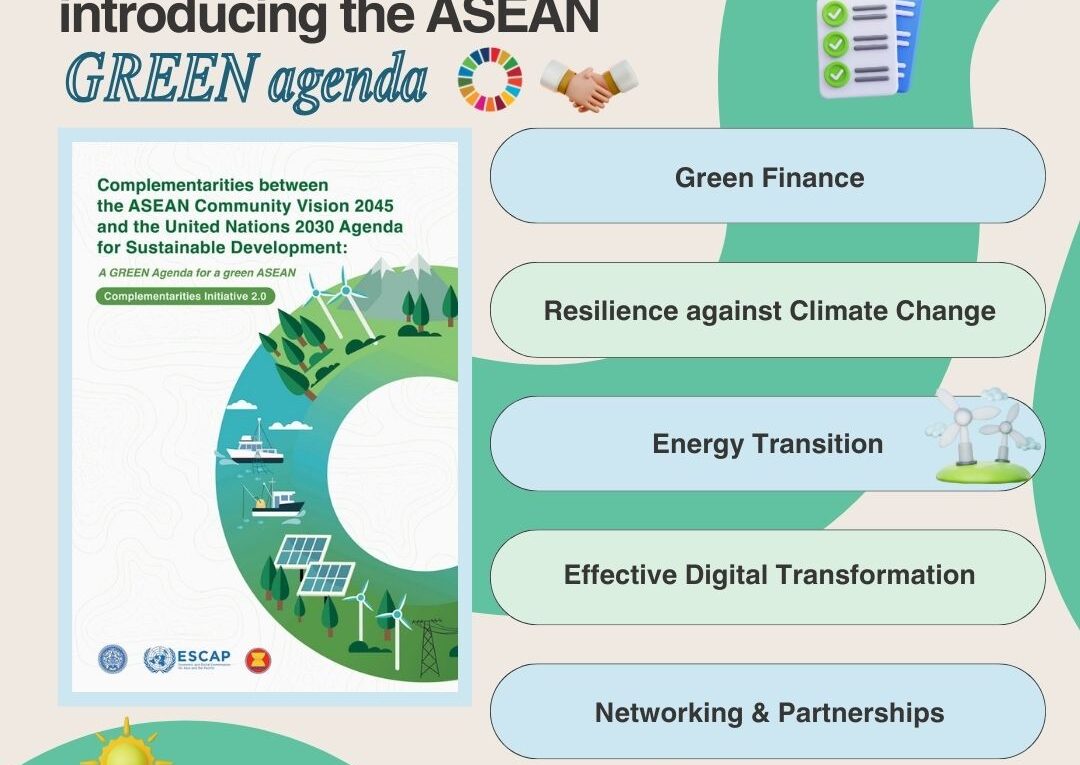
The CI 2.0 identifies five new priority areas for action, reflecting changing global conditions, ASEAN leaders’ ambitions, and building upon lessons learned from CI 1.0 These new priority areas are critical for aligning with the ACV 2045’s vision of a “green ASEAN” and effectively achieving the SDGs. The new priority areas, which can be labelled as a GREEN agenda, consist of the following:
🌱 ASEAN Complementarities 2.0 Priority Areas (GREEN Agenda)
Resilience against Climate Change .
Effective Digital Transformation .
Green Finance: Green Finance is crucial for achieving a rapid transition to a green economy and meeting the region’s energy needs sustainably. Initial SDG indicators for Green Finance show mixed progress. Access to Electricity (SDG 7.1.1) and Internet Users (SDG 17.8.1) demonstrate good progress. However, Passenger and Freight Volume (SDG 9.4.1) has significantly regressed, with most AMS showing stagnation. While other indicators show progress, substantial improvement is needed to meet UN Green Finance SDG goals by 2030.

Resilience against Climate Change: This Priority Area focuses on strengthening ASEAN’s capacity to adapt to climate-related hazards and natural disasters. Nine initial SDG indicators for Resilience against Climate Change indicate that significant progress is still required for ASEAN to meet UN Climate Change SDG goals by 2030. It also underscores the need for robust data for effective monitoring and policy formulation.
Energy Transition: Energy transition aims to shift towards sustainable energy practices, decarbonize energy systems, increase renewable energy share, and enhance energy security. ASEAN has ambitious renewable energy targets: 23% share in Total Primary Energy Supply (TPES) by 2025 and 35% in installed power capacity. Ten SDG indicators were selected, with seven showing improvement. Access to Electricity (SDG 7.1.1) showed the greatest progress and is near the 2030 target. However, Material Footprint (SDG 12.2.1) has significantly regressed. Despite solid gains, considerable improvement is needed to close the gap. Ensuring a just and inclusive energy transition, particularly for vulnerable populations, remains a significant challenge, requiring targeted policies, retraining, and local stakeholder engagement.
Effective Digital Transformation: The COVID-19 pandemic accelerated digital transformation, firmly establishing it as a cross-cutting imperative for economic and social Complementarities Initiative 2.0 14 development. ACV 2045 envisions a leading, connected Digital and Technological Community with an open, interoperable, secure, and trusted digital ecosystem. This includes leveraging advanced technologies like IoT, AI, and big data to enhance economic integration, digital innovation, and cybersecurity, in ways that drive efficiencies and supports sustainable practices across all sectors. The ASEAN Connectivity Strategic Plan emphasizes a continuously innovative digital ecosystem that advances cybersecurity, supports efficient cross-border data flows, and promotes digital inclusion, addressing the digital divide and ensuring safe, inclusive access to digital technologies.
Networking and Partnerships: This area is crucial for strengthening internal cohesion and building impactful partnerships across ASEAN’s three pillars. Hurdles exist in developing effective Public-Private Partnerships (PPPs), including regulatory uncertainty, high upfront costs, risk allocation challenges, limited expertise, and difficulties in stakeholder coordination. Externally, ASEAN faces challenges in maintaining its centrality amidst competing major power initiatives and varying levels of trust with dialogue partners
📚 Featured Publications & Research
- 📘 ACESP Publication Archive: Click here
- 📊 ASEAN SDG Indicators Progress Report 2025: Click here
- 🔬 ACSDSD’s Contribution to Regional Sustainability Research (CMMU & MFA): Grant Criteria
🌟 ACSDSD Main Events in 2025
- ♻️ ASEAN Circular Economy Forum (ACEF 2025): Click here
- 👥 ASEAN Youth Camp for Sustainable Development 2025: Click here
- 🌐 ASEAN Acceleration: Multi-Stakeholder Forum on Sustainability (Formerly 9th HLBD): Explore
- 🔗 Fostering Synergy across ASEAN: ACSDSD Spotlight
#WeareCircularASEAN